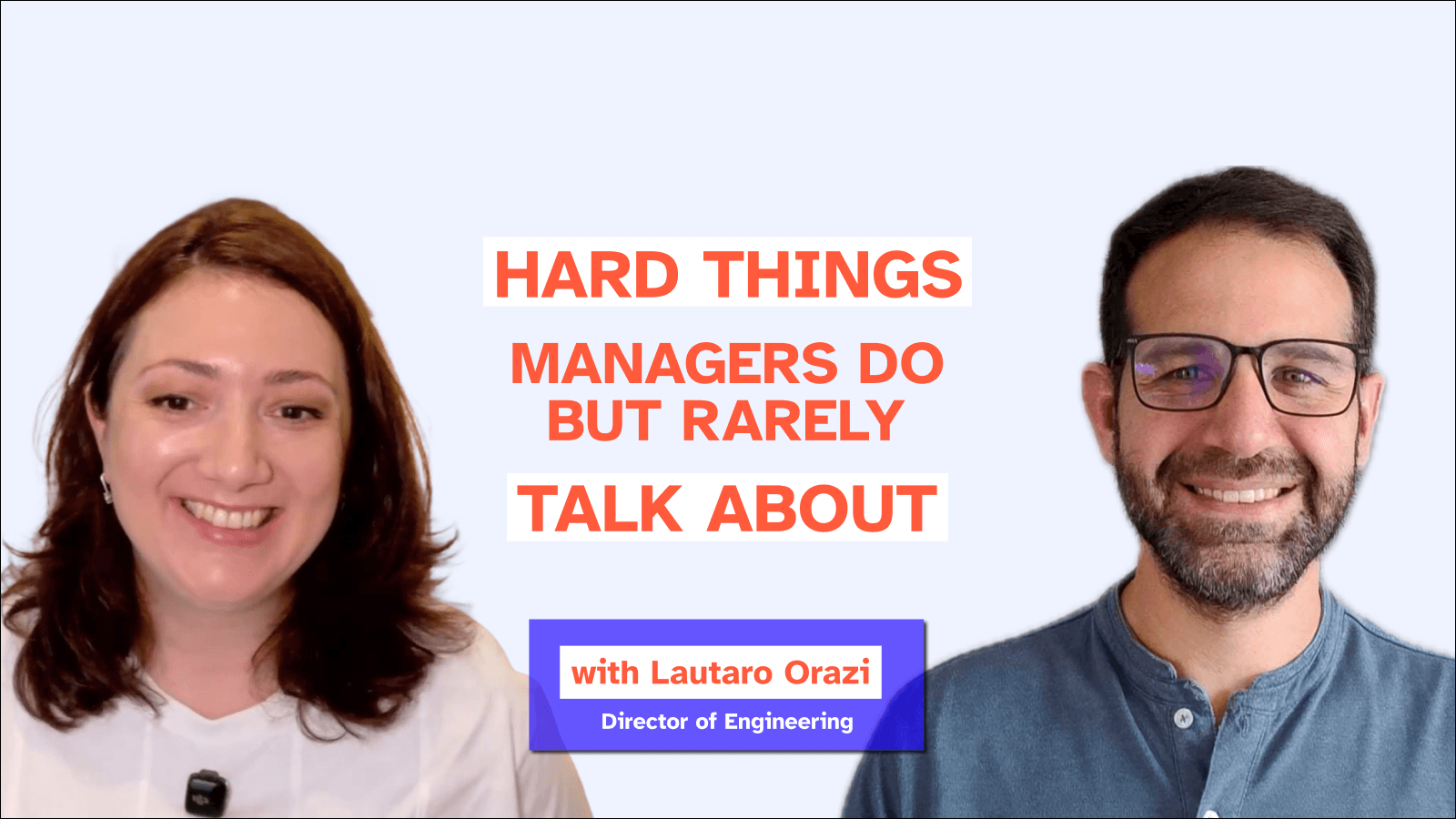
Managers in technology like to celebrate amazing things their teams build but there are some necessary and very real parts of their job they don't like to talk about. Alla Babkina, founder of Innovective, meets with Lautaro Orazi, Director of Engineering and former colleague at Theorem, to compare notes.
This is Episode 1 of the Innovective Podcast , where we share learnings on building and scaling teams, products and platforms. Remember to subscribe to our channel!
- How can we grow more full-stack engineers to meet demand?
- What do new, junior, managers look like?
- Choosing between management and individual contributor path
- Handling pay review and promotions
- When to hire and when to promote internally
- Dealing with conflict breaching professional boundaries and contract
- Resetting expectations and disappointment
- Life, death and war scenarios
- Feedback no one wants to give
- Growing self-awareness as a leader
What we talked about
Why we recorded this episode
Alla and Lautaro worked together at Theorem, and both have managed people across engineering, consulting and leadership roles. Managers are happy to talk about what their teams build. They're much quieter about the decisions they find hardest, and those are what this episode is about, drawn from our own experience.
Indecision costs more than a wrong call
One theme kept coming back: not deciding often does more damage than deciding badly. Decisions are hard, and that's exactly why leaders delegate them to managers, with some autonomy and some checks. A manager's job is to decide with the information available, accept that some calls will be imperfect, and keep an eye on the outcome so they can correct course. Waiting for perfect information leaves the team stuck, and a decision that's never made still has consequences.
From individual contributor to manager
Moving from engineering into management is a leap, not a step. New managers often struggle to let go of hands-on work. They have to learn to delegate, and to shift their attention from the technical problem to the people and the context around it. That takes time. Being a junior manager is a normal stage, in the same way that every engineer was once a junior engineer, and nobody should expect to be good at it straight away. New managers should also expect to learn things they never had to think about before: HR processes, employment law, budgets and how the wider business works.
Management or the technical track?
Lautaro's view is that people should choose the path that fits their strengths and what motivates them, not the one that comes with the title. Some people want the title without the work that comes with it. Others move into management because they believe it's the only way to keep growing. A good manager helps people see the alternatives, such as staff or principal engineer roles, where they can grow their impact without managing people. Strong technical people can also become strong leaders, but usually after a long and deliberate period of growth rather than a sudden promotion.
Conflict that helps, and conflict that harms
Not all conflict is bad. Some conflict is productive, and some damages teams. The advice is to address disagreements early, before they grow, and to keep the conversation focused on the work rather than the people. When a resolution can't be reached collaboratively, it's time to involve HR. Document issues from the start, not once things have already escalated, so there's a clear record if the situation gets worse.
How much should the team know?
Politics are part of the job, and a manager constantly decides how much context to share. Our general view: teams should hear about significant business changes, such as a reorganisation, an acquisition or a change of client, early enough to prepare for them. At the same time, managers should protect their people from speculation and from anxiety about things that may never happen.
Pay, raises and fairness
Pay decisions are some of the hardest conversations a manager has. We talked about people who are paid above their level, the limits that budgets and pay equity put on what a manager can offer, and how to turn down a raise honestly. The recurring advice was to be transparent about what drives pay, to explain the business reasons behind a decision, and never to promise an increase you can't guarantee. Saying no honestly matters more than leaving someone with false expectations.
Hiring and team culture
Hiring isn't only about filling a role. Sometimes it's worth hiring above budget for the right person. Sometimes a team that has stalled needs someone new to break old patterns and bring fresh energy. Different management styles suit different people and different needs, and a team benefits from more than one way of leading.
The work nobody puts in the handbook
Some of the hardest parts of management never make it into an HR manual. Someone has to make sure the boring but necessary work gets done. Some people lack basic workplace skills, and a manager has to address that. Cross-cultural communication adds another layer. Rarely, but seriously, managers face situations such as an employee in crisis.
These situations are rarely covered in HR manuals. What carries managers through them is experience, support from peers and clear processes.